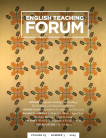
On the Cover: Oak Leaf and Currants, part of the Smithsonian American Art Museum collection, is a quilt that dates from the mid-20th century. The oak leaves on the quilt’s 20 squares are golden brown, suggesting the season of autumn, when temperatures in many parts of the United States turn cool, leaves turn color and fall from trees, and quilts come in handy for keeping people warm. The currants—small, tart berries—in this quilt are brown ... except for one square, in which the currants are white. Why do you suppose the quilter decided to make that square different?
 Text (PDF)
International Subscriptions: English Teaching Forum is distributed through U.S. Embassies. If you would like to subscribe to the print version of English Teaching Forum, please contact the Public Affairs or Cultural Affairs section of the U.S. Embassy in your country.
U.S. Subscriptions: English Teaching Forum is exempted from the Congressional restriction on distribution of Department of State-produced materials in the United States. U.S. residents who want to order the printed edition can order from the U.S. Superintendent of Documents.
Author Tim Stoeckel describes the Repeated Reading with Retelling (RRR) activity, which combines the strengths of the well-known “4/3/2” and “repeated reading” techniques. RRR gives students at nearly all language levels practice in multiple language skills and can be used with a variety of text types, making it a fit in a wide range of language-learning classes.
Author Aaron Mermelstein explains the importance of accurately placing learners at the correct level for reading practice, then describes the Reading Level Measurement Method, a student-centered device that can be used to measure students’ placement (and progress) and can give reading instructors important information about the effectiveness of their reading program.
This guide is designed to enrich your reading of the articles in this issue. You may choose to read them on your own, taking notes or jotting down answers to the discussion questions below. Or you may use the guide to explore the articles with colleagues.
Author Florence Elizabeth Bacabac takes the reader through a series of detailed steps that demonstrate how to help students think (with a focus on cognitive awareness), talk (using communicative activities), and write (applying grammar in writing contexts. The author shows how digital tools can align with the principles of critical thinking and audience awareness.
Format: Text
Brittany Gnau uses the lyrics from a popular, traditional song, “Down by the Bay,” as the basis for a variety of activities that give students chances to think, rhyme, sing, dance, have fun ... and practice using English!
Format: Text
The author uses real-life examples to show how the practice of Gentle Teaching can be applied in the language-learning classroom. Bellarina-Dung Nguyen explains the pillars of the approach and gives readers insight into how teachers can use it to create a classroom atmosphere that can promote learning for all.
Format: Text
Wing Wu describes techniques for helping students create AI-generated images of people and suggests various activities that make use of the images. The author uses step-by-step guides to explain how students get practice creating prompts, developing written and spoken descriptions, and collaborating.
Format: Text
Can you change one letter in each word to spell the name of a sport? (A bonus puzzle gives you a chance to change one letter to spell a kind of animal.)