Browse online English Teaching Forum issues and articles dating back to 2001. To find a particular article or issue, filter the past issues by year.

Search Past Issues of Forum by Year

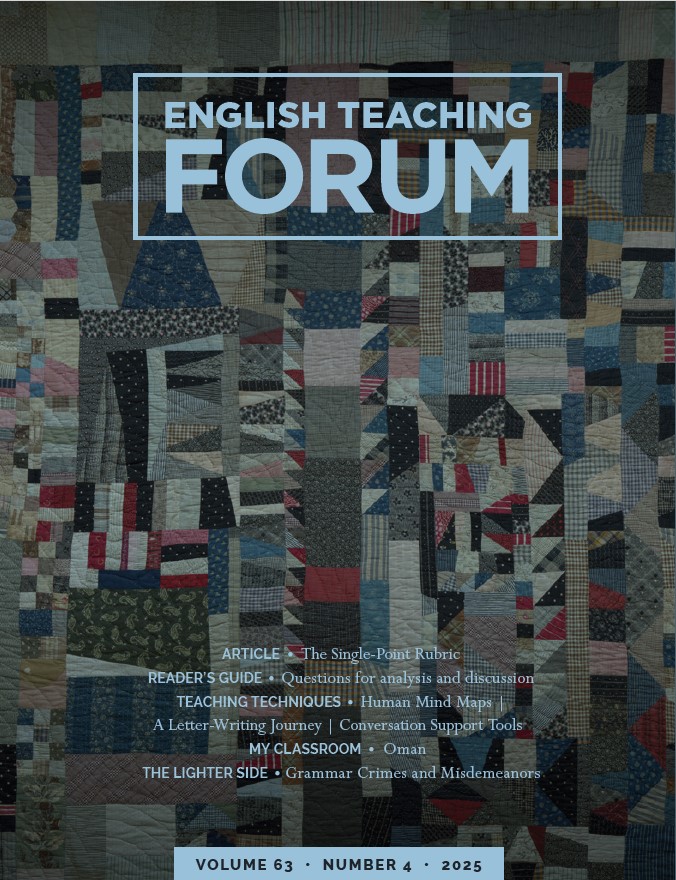
English Teaching Forum 2025, Volume 63, Number 3
Learn how to apply the Repeated Reading with Retelling technique ... assess your students’ reading level with the Reading Level Measurement Method ... use digital tools with a think-talk-write design ... have language fun with “Wordplay Runway” ... incorporate Gentle Teaching principles into your classes ... bring descriptions of people to life with AI-generated images ... and much more.

Think-Talk-Write Design: Digital Tools for Language Autonomy and Writing Literacies

Florence Elizabeth Bacabac
Author Florence Elizabeth Bacabac takes the reader through a series of detailed steps that demonstrate how to help students think (with a focus on cognitive awareness), talk (using communicative activities), and write (applying grammar in writing contexts. The author shows how digital tools can align with the principles of critical thinking and audience awareness.

Wordplay Runway: Fun with Phonology and Music

Brittany Gnau
Brittany Gnau uses the lyrics from a popular, traditional song, “Down by the Bay,” as the basis for a variety of activities that give students chances to think, rhyme, sing, dance, have fun ... and practice using English!

Gentle Teaching: Creating a Positive Atmosphere in Young-Learner Classrooms

Bellarina-Dung Nguyen
The author uses real-life examples to show how the practice of Gentle Teaching can be applied in the language-learning classroom. Bellarina-Dung Nguyen explains the pillars of the approach and gives readers insight into how teachers can use it to create a classroom atmosphere that can promote learning for all.

Bringing Descriptions of People to Life Using AI-Generated Images

Wing Wu
Wing Wu describes techniques for helping students create AI-generated images of people and suggests various activities that make use of the images. The author uses step-by-step guides to explain how students get practice creating prompts, developing written and spoken descriptions, and collaborating.

The Lighter Side: Spell a Sport

Can you change one letter in each word to spell the name of a sport? (A bonus puzzle gives you a chance to change one letter to spell a kind of animal.)

Repeated Reading with Retelling: A Multi-skilled Fluency Activity

Author Tim Stoeckel describes the Repeated Reading with Retelling (RRR) activity, which combines the strengths of the well-known “4/3/2” and “repeated reading” techniques. RRR gives students at nearly all language levels practice in multiple language skills and can be used with a variety of text types, making it a fit in a wide range of language-learning classes.

A Simple and Authentic Assessment of Language Learners’ Reading Abilities: The Reading Level Measurement Method

Author Aaron Mermelstein explains the importance of accurately placing learners at the correct level for reading practice, then describes the Reading Level Measurement Method, a student-centered device that can be used to measure students’ placement (and progress) and can give reading instructors important information about the effectiveness of their reading program.

Reader’s Guide

This guide is designed to enrich your reading of the articles in this issue. You may choose to read them on your own, taking notes or jotting down answers to the discussion questions below. Or you may use the guide to explore the articles with colleagues.
English Teaching Forum 2025, Volume 63, Number 2
Cover of English Teaching Forum, Volume 63, Issue 2
Learn how to plan and conduct workshops with the Community of Inquiry framework ... guide your students to create innovative podcasts ... see how scavenger hunts provide fun ways to use English ... give learners opportunities to fill gaps in stories they read ... read about a place-based language-learning project in Bolivia ... make decisions about a college budget ... and much more.

Community of Inquiry as a Suitable Framework for Planning and Conducting English Language Teaching Workshops

Jimalee Sowell
Author Jimalee Sowell explains the branches of the Community of Inquiry framework and shows how they can be applied to ELT workshops. Numerous examples are given, along with a sample workshop design that is based on collaborative writing but can serve as a model for workshops on other topics.

Innovative Student-Podcasting Activities: Enhancing Language and 21st-Century Skills

Enock Mbenza
Creating podcasts gives students opportunities to practice English in meaningful ways, be creative, and develop skills that can be put to use inside and outside the classroom. Author Enock Mbenza offers specific examples and provides organizational templates that students can apply to almost any topic.

Reader’s Guide

This guide is designed to enrich your reading of the articles in this issue. You may choose to read them on your own, taking notes or jotting down answers to the discussion questions below. Or you may use the guide to explore the articles with colleagues.

Scavenger Hunts in ELT

Laura Loder Buechel
Laura Loder Buechel explores the many ways that scavenger hunts can add fun, movement, collaboration, and practical applications of knowledge to English language learning. The article includes detailed descriptions of different kinds of hunts, many of which are appropriate for young learners, and includes templates and ready-to-use ideas.

Reading (and Writing) beyond the Lines

Vanesa Polastri
Author Vanesa Polastri loves to give her learners stories (and other texts) that contain “gaps of indeterminacy”—that is, missing information that the learners must provide by using hints in the texts, their own knowledge, and their imagination. The author suggests ways the technique can be used for learners of different ages and language levels.

My Classroom: Bolivia

Learn how Claudia Andrade Serrano engaged her students with a place-based language-learning project that involved planting churqui-tree “seed bombs.” Students used English throughout the project, from making and planting the seed bombs to writing and sharing original poems about nature. The article, written by Susan Huss-Lederman, conveys the students’ enthusiasm and includes thoughts on how other teachers can try similar projects of their own.

A Challenge with the College Budget

Aaron Mermelstein
Aaron Mermelstein offers a ready-to-use way to give students a chance to make decisions about projects that could improve their college campus. The challenge is that the budget cannot cover every project, so students must decide which projects to fund—and they must be ready to defend their decisions.

The Lighter Side: IDEA

Can you complete the given sentences and create i-d-e-a sentences in this puzzle, which is based on the word idea?
English Teaching Forum 2025, Volume 63, Number 1
Cover of American English Journal, Volume 63, Issue 1
Find strategies for starting a storytelling club ... using interactive video ... exploring variations in spoken English language ... guiding students to write restaurant reviews ... using multisensory activities for listening practice ... and much more.

Storytelling Clubs: A Multilingual, Multimodal Approach

Riah Werner
Riah Werner uses her experience with a storytelling club in Tanzania to give guidance for starting, customizing, and maintaining storytelling clubs in other contexts. The article provides options and suggests specific activities for those who are interesting in starting a similar club of their own.

Using Interactive Video to Boost Engagement in Online Courses, MOOCs, and More

Christine Eide
Author Christine Eide shows how teachers can incorporate interactive video into their lessons to give learners customized practice and to increase their engagement with content. The article features numerous examples and a detailed interactive video lesson plan.

Activity Proposal to Work with English Language Variation: Focus on the Phonetic-Phonological Level

Adriano Delego
Author Adriano Delego demonstrates why it is important for learners to be able to understand variations in English language spoken around the world, then describes six activities teachers can use to give their students practice in listening to and comprehending different varieties of English.

Reader's Guide

This guide is designed to enrich your reading of the articles in this issue. You may choose to read them on your own, taking notes or jotting down answers to the discussion questions below. Or you may use the guide to explore the articles with colleagues.

Writing Restaurant Reviews Online

Joshua Lee
Joshua Lee provides detailed, step-by-step guidelines for helping students write their own restaurant reviews. The article takes readers through the entire process of choosing a restaurant, filling out the provided observation form while there, and then drafting and revising a review.

A Good Listener Is a Good Speaker: Three Multisensory Activities

Anita Demitroff, Anne Haggerson
As the title suggests, this article describes three activities that give learners listening and speaking practice in fun, imaginative ways. The authors suggest ways to adapt the activities for young learners, advanced learners, and large classes, making the article relevant to teachers in a variety of contexts.

The Lighter Side: QUaEnSsTwIeOrNsS

In this puzzle, questions and their answers are mixed together. Can you unscramble each group of words to form a question and an answer that goes with it?